In 2025, the classroom has changed, and so have the children in it. Many students are arriving at school carrying the weight of global uncertainty, rising living costs, and ongoing community instability in their invisible backpack.
Where I live, the housing crisis means families are moving frequently, couch-surfing, or sharing overcrowded homes. I’ve even supported families sleeping in their cars or in motel rooms provided by local homelessness services. Groceries have become increasingly unaffordable for families on minimum wages or single incomes (seriously – how is one bag of groceries now a minimum of $50 at major supermarkets?).
For many children, these stressors don’t just shape their evenings and weekends – they shape their developing brains. When they come to school, their experiences are not magically erased; they are carried with them everywhere.
Against this backdrop, the expectation that students can jump straight into higher-order thinking feels less realistic than ever. A child navigating exhaustion, hunger, fear, or instability cannot simply “push through” to analyse, evaluate, or create.
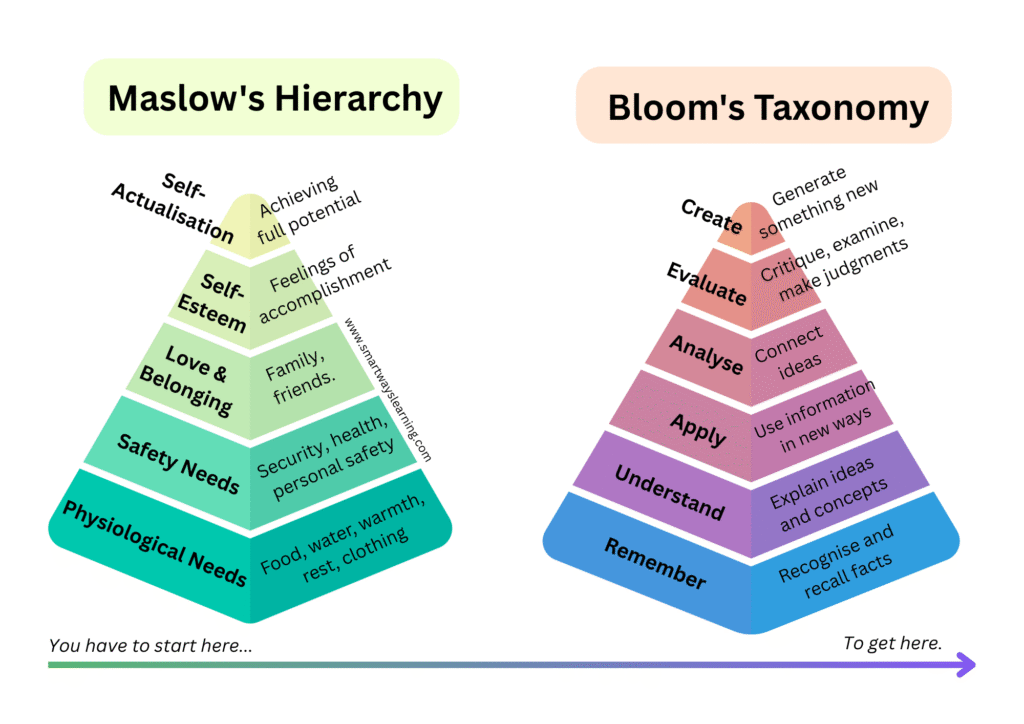
Students cannot climb Bloom’s Taxonomy if they are stuck at the bottom of Maslow’s Hierarchy of Needs.
In other words: You have to Maslow before you can Bloom.
Maslow Before Bloom: Why the Foundation Matters
Maslow’s Hierarchy of Needs reminds us that no amount of rich tasks or beautifully designed lessons can override a brain in survival mode. When survival and safety needs – sleep, food, water, security – are missing, the brain’s priority is not learning. It is survival.
This is even more pronounced for students in situations like out-of-home care, where belonging needs are disrupted by family separation, placement changes, or instability in carers.
After years of disrupted schooling, ongoing economic pressure, and unpredictable home environments, more students than ever are arriving at school without the foundations required for cognitive stretch. Many have nervous systems stuck in hypervigilance or shutdown due to an overactive amygdala. Others lack the emotional or physical resources to learn because their cognitive capacity is consumed by survival.
This is not a lack of motivation or resilience.
It is biology.
Bloom’s Taxonomy: The Thinking Students Can’t Access Without Safety
Bloom’s Taxonomy maps the skills we hope students will master: remembering, understanding, applying, analysing, evaluating, and creating. Each of these requires:
- working memory
- emotional regulation
- sustained focus
- flexible thinking
- the ability to take risks
All of these rely on a calm, regulated body and brain.
A child who does not feel safe cannot effectively engage in tasks on Bloom’s Taxonomy because their cognitive resources are being used to manage stress, threat, or uncertainty.
For students who live in a constant state of fight, flight, freeze, fawn, or faint (oh yeah, there’s 5F’s), the upper regions of the brain responsible for rational thinking – especially the prefrontal cortex – go offline. This is the result of Amygdala Hijack: when threat is detected (real or perceived), the amygdala activates and suppresses higher-order thinking.
You don’t need to think in these moments.
You just need to survive.
What Students Are Communicating When They “Can’t Learn”
In trauma-aware practice, all behaviour is communication.
When students consistently present as distracted, avoidant, oppositional, withdrawn, or disorganised, it’s often a sign that unmet needs are interfering with learning. A student might be communicating:
- “I didn’t sleep last night.”
- “I haven’t eaten since yesterday.”
- “My family might have to move again.”
- “My body doesn’t feel safe right now.”
- “I don’t belong here.”
Understanding this reframes behaviour not as defiance, but as distress.
Practical Ways to “Maslow” in the Classroom
Supporting the lower levels of Maslow doesn’t require grand programs or specialist training. It requires intentional, humane teaching.
Here are strategies that make a tangible difference:
1. Create Predictability Through Routines
A consistent timetable, clear expectations, and gentle transitions support the nervous system to move calmly through the day. Predictability equals safety—especially when home life is unpredictable.
2. Build Strong, Attuned Relationships
Greeting students by name, noticing their efforts, and offering connection are not “soft skills” – they are neurological needs. The first weeks of school are chaotic, but intentionally building a sense of class community fosters belonging and safety.
3. Offer Co-Regulation
A calm adult helps settle an unsettled child because of how mirror neurons work in the brain – these specialised neurons cause us to automatically “mirror” the emotions, tone, and body language of the people around us. When a teacher is regulated, steady, and grounded, a dysregulated student’s nervous system can begin to match that state.
Stay calm. Speak slowly. Move deliberately.
Your presence is a powerful intervention.
Remember your body language and facial expression – towering over a child with crossed arms and a scowl doesn’t promote regulation. It signals threat, which triggers even more dysregulation.
4. Incorporate Physical Needs Check-Ins
Simple supports – movement breaks, hydration, stretching, and quiet moments – are essential for maintaining cognitive and emotional capacity. Movement increases oxygen flow and resets attention; hydration sustains working memory and mood; stretching releases stress-related tension; and quiet pauses calm the nervous system, allowing the prefrontal cortex to re-engage.
These micro-interventions don’t take time away from learning, they create the conditions that make deep learning possible.
5. Support Students Experiencing Home Challenges
Work closely with families to build realistic support plans.
In the classroom, use scaffolding, visuals, chunked tasks, and reduced cognitive load.
Outside the classroom, consider practical adjustments—such as paper homework instead of digital assignments for families without reliable technology or Wi-Fi.
6. Provide Safe Spaces: Calm Corners, Breakout Areas, and Regulation Zones
A safe physical space can be transformative. Students dealing with instability or emotional overload need somewhere to reset, regulate, and return to learning.
Calm Corners
A small space with soft seating, sensory tools, breathing visuals, or calming prompts. Not a time-out space—a regulation resource. It helps to explicitly teach students when to use it, and how to spend their time there.
Breakout Spaces
An alternative spot where students can work quietly, take a sensory break, or reduce overstimulation.
Mini Regulation Kits
Noise-cancelling headphones, fidgets, stress balls, sand timers, emotion scales – tools that help the body and brain calm.
Predictable Procedures for Using These Spaces
Clear, shame-free routines empower students to self-regulate without fear of getting in trouble.
These spaces communicate:
You are safe. You are welcome. Your needs matter here.
Only when students feel these things can they begin to climb Bloom’s.
When We Prioritise Maslow, Bloom Becomes Possible
Once students experience safety, belonging, connection, and regulation, everything opens. Engagement rises. Curiosity increases. Students take risks. They participate. They create. Their capacity for deep cognitive work grows.
Trauma-aware, needs-first teaching isn’t lowering expectations—it’s creating the conditions in which high expectations can finally be met.
Academic rigour requires emotional safety.
Cognitive challenge requires physical stability.
Higher-order thinking requires lower-order needs.
In short: You have to Maslow before you can Bloom.
References & Further Reading
Buksh, S. (2020). Maslow before Bloom. Independent Education, 50(2), 20-21.
Mutch, C., & Peung, S. (2021). ‘Maslow before Bloom’: Implementing a Caring Pedagogy during COVID-19. New Zealand Journal of Teachers’ Work, 18(2), 69-90.
https://www.pacesconnection.com/blog/it-is-critical-to-maslow-before-students-can-bloom
https://www.edutopia.org/article/how-maslow-bloom-all-day-long