When we are teaching, we are fundamentally working with the brain. So why wouldn’t we use neuroscience to better understand what is ging on in our student’s minds?
In particular, understanding how the brain responds to stress and trauma is essential for any educator who works with young people – particularly those who have experienced adversity, out-of-home care, or ongoing instability. Models such as Bruce Perry’s Neurosequential Model, Dan Siegel’s Hand Model of the Brain, and Polyvagal Theory help us translate complex neuroscience into actionable classroom practice.
Below is a simple, educator-friendly guide to the key parts of the brain, how students process information, what happens during a survival response, and what you can do in moments of escalation.
Parts of the Brain to Understand
1. Brain Stem
The brain stem is the first part of the brain to receive sensory information from the environment – sounds, smells, body sensations, light, movement. Its job is to take in this raw sensory data and pass it upward toward the limbic (middle/emotional) brain.
It also works with the cerebellum to regulate motor movement and balance.
When students feel unsafe or overstimulated, the brain stem goes on high alert, tuning them toward threat detection rather than learning.
2. Amygdala
The amygdala is the brain’s survival response center. It activates fight, flight, freeze, fawn, or faint reactions whenever danger – real or perceived – is detected.
Importantly, if the amygdala senses a threat, information processing stops right here. Students can no longer access rational decision-making, reasoning, or problem-solving. This is known as amygdala hijack.
In learners with trauma histories, MRI studies show enlarged amygdalae, making this survival system even more sensitive and reactive.
3. Hippocampus
The hippocampus stores memory. A crucial piece for teachers to know is this:
The hippocampus cannot tell time.
This means a student may react to a memory as if the event is happening right now. A smell, tone of voice, classroom noise, or unexpectedly close proximity might trigger a response that seems disproportionate – but is actually the brain reliving something frightening.
4. Prefrontal Cortex
The prefrontal cortex (PFC) is the brain’s “thinking brain,” responsible for planning, self-regulation, problem-solving, and logical reasoning. Two key areas matter most in the classroom:
- Orbitofrontal Cortex (OC):
Supports rational decision-making and evaluation of consequences. - Anterior Cingulate Cortex (ACC):
Connects the limbic brain to the cognitive brain. It helps with emotion, reward, decision-making, attention, and focus.
In trauma-impacted brains, MRI studies show reduced grey matter in both the OC and ACC. Like muscles, neural networks grow strongest where they’ve been used the most—so survival pathways can become over-developed, and regulation or reasoning pathways under-developed.
Why This Matters for Teachers: Bottom-Up Processing
Perry’s work shows that all information arrives in the brain in a bottom-up sequence:
Brain stem → Amygdala → Hippocampus → Prefrontal Cortex
If the amygdala senses danger at any point, the processing chain stops. No amount of logic, reminders, consequences, or “make a good choice” statements can override a survival response.
Students can only access the upper parts of the brain once they feel safe again.
Understanding This Through Siegel’s Hand Model
Dr. Daniel Siegel’s Hand Model of the Brain is a simple and powerful visual to show what happens during an amygdala hijack. When a student “flips their lid,” the thinking brain (fingers) lifts away from the emotional brain (thumb).
This two-minute video from Dr. Siegel explains the hand model clearly and concisely:
Window of Tolerance
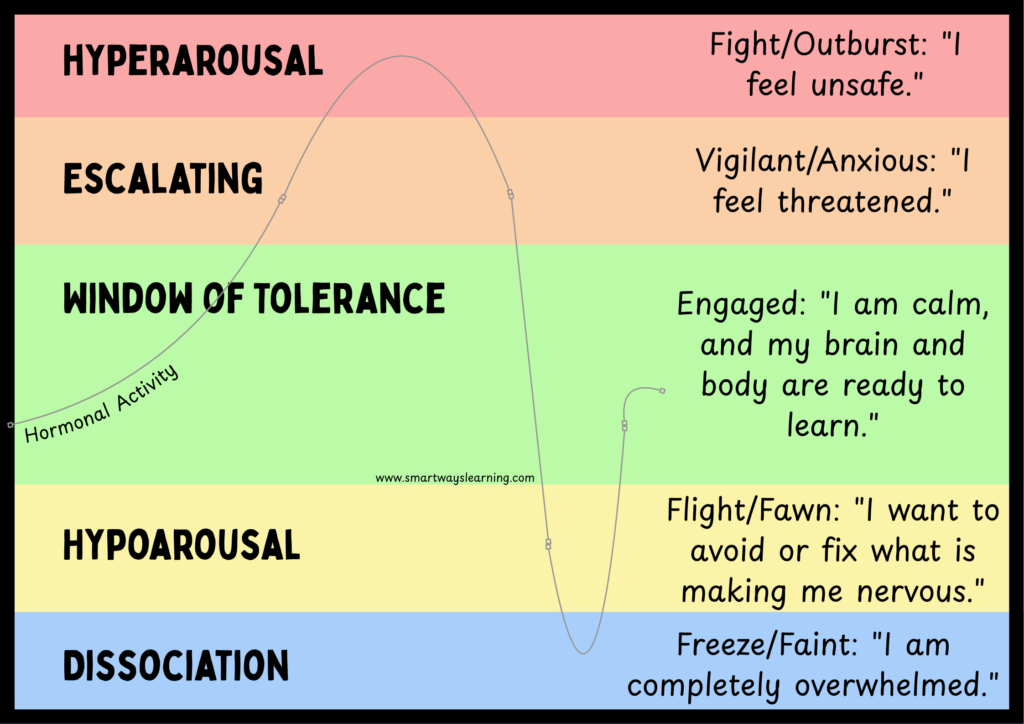
The Window of Tolerance is something we all have, and fluctuations throughout the day are completely normal. The problem begins when students go too far out of their windows, and they cannot regulate themselves back into the window of tolerance once they have left it. In the diagram, this is the green zone, where students can learn, problem-solve, and stay flexible. Outside that window, students drop into:
- hyperarousal (fight/flight), or
- hypoarousal (flight/freeze/fawn/faint).
Students will communicate through their behaviour. This is what teachers often interpret as defiance, distraction, refusal, aggression, or “shutting down” – but it is actually a nervous system state, not a choice.
Strategies to Help Students Regulate Survival Responses
Here are trauma-informed, neurobiologically-aligned ways to support a student back into their Window of Tolerance:
1. Start With the Body (Brain Stem First)
Since processing begins in the brain stem, regulation strategies must start there.
- Slow, regulated breathing (paced breathing, square breathing)
- Rhythmic movement (walking, rocking, cross-body motions)
- Sensory grounding (cold water, textures, weighted items)
- Hydration and snacks
- Stretching, shaking out limbs, wall pushes
- A quiet corner or low-stimulus environment
These help calm the nervous system before any talking.
2. Offer Co-Regulation
Your calm is their calm.
- Use a slower, quieter voice
- Sit or kneel nearby (without crowding)
- Keep facial expressions and body language soft and predictable
- Match their breathing pace and invite them to join
- Narrate safety: “You’re not in trouble. I’m here with you.”
This connects to Polyvagal Theory – students detect safety primarily through cues of social engagement.
3. Support the Emotional Brain
Once the amygdala releases its grip:
- Name feelings without judgment (“It looks like you’re feeling overwhelmed. That makes sense.”)
- Validate the stress response (“Your brain was trying to protect you.”)
- Provide choices to regain control (“Would you like to sit by the window or near the door?”)
4. Engage the Thinking Brain
Only after safety and emotional regulation are restored can you move to skill-building:
- Reflective conversation
- Problem-solving dialogues
- Restorative practices
- Simple instructional redirection
- Executive functioning scaffolds (visuals, checklists, timers, routines)
Final Thoughts
Trauma-informed education isn’t about lowering expectations – it’s about understanding the brain states that make learning possible.
By aligning classroom practices with how the brain processes information bottom-up, and by recognising when a student’s survival system has taken over, teachers can respond with compassion, clarity, and neuroscience-informed strategies that restore safety and prepare the brain for learning again.
References & Further Reading
Ayre, K., & Krishnamoorthy, G. (2020). 3.6 Using the window of tolerance in the school context. Usq.pressbooks.pub. https://usq.pressbooks.pub/traumainformedpractice/chapter/3-6-using-the-window-of-tolerance-in-the-school-context/
Perry, B. D., & Dobson, C. L. (2013). The Neurosequential Model of Therapeutics. In J. D. Ford & C. A. Courtois (Eds.), Treating Complex Traumatic Stress Disorders in Children and Adolescents (pp. 249–260). Guilford Press.
Perry, B. D. (2021). What Happened to You? (with Oprah Winfrey). Flatiron Books.